
Penetration Testing & Security Assessments
Comprehensive offensive security testing to identify vulnerabilities across applications, networks, cloud, devices, and people.
We served more than 50+ entities across the Kingdom
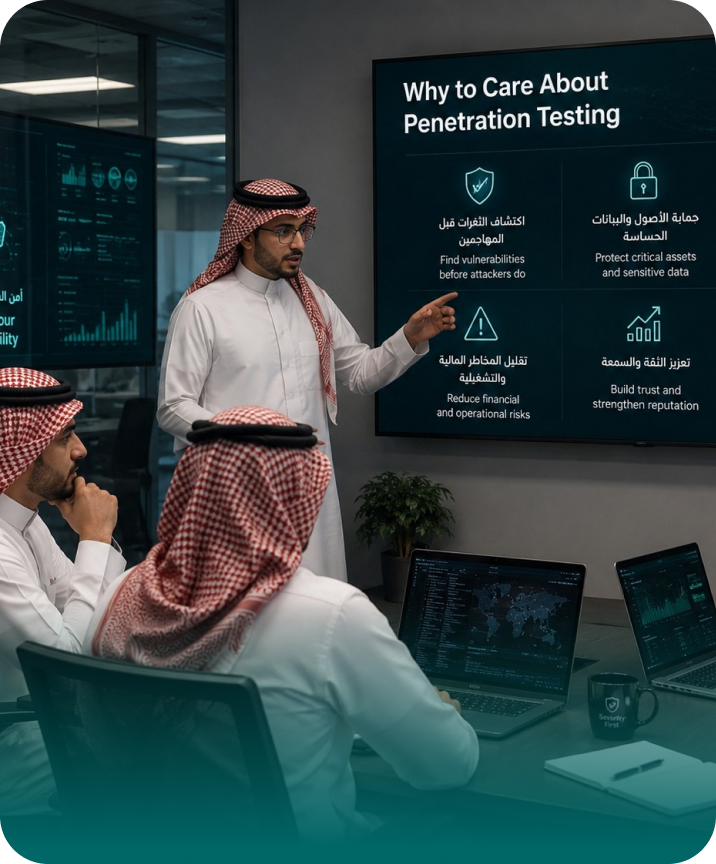
Why Your Company Should Care About Penetration Testing

SAR 34.7 million — the cost of the most expensive open door in Saudi organizations
According to IBM’s 2026 report, the three costliest breach vectors in the Kingdom are internet-exposed applications, followed by misused valid accounts, then phishing. All three are weaknesses that a single, well-designed penetration test can uncover — at a cost that pales next to discovering them too late. The difference between an organization that gets breached and one that withstands an attack isn’t how many solutions it has purchased, but how precisely it knows its own weak points before anyone else does.
Realistic attack simulation, not automated scanning
Test your defenses with realistic scenarios.
Documented proof of exploitation for every vulnerability
Identify weaknesses before they become threats.
Clear remediation priorities, not long lists
Necessary for ISO, NCA, PCI, and many regulations.
Reports accepted by regulators on the first submission
Strengthens systems through actionable remediation.
Retesting to confirm closure
Ongoing pentesting ensures long-term security.
How We Help you Achieve More with Penetration Testing
Application Security Testing
Web, mobile, and API testing, following the OWASP Web Security Testing Guide and the MASVS standard for mobile.
Network and Infrastructure Penetration Testing
External testing from an internet-facing attacker’s perspective, and internal testing from the perspective of a compromised employee or device — covering wireless networks, Active Directory, and privilege escalation paths.
Cloud Environment Testing
Review of Azure, AWS, Google Cloud, and Microsoft 365 configurations, identities and permissions, and exposed storage, in accordance with the Cloud Cybersecurity Controls (CCC-1:2020).
Social Engineering
Simulated phishing campaigns via email, phone, and messaging, along with unauthorized physical access attempts, to assess the readiness of the human element — not just the systems.
Adversary Simulation — Red Team
A multi-stage offensive operation simulating a real threat actor targeting your sector, to measure your defensive team’s ability to detect and respond, based on the MITRE ATT&CK framework.
How We Help you Achieve More with Penetration Testing
Application Security Testing
Web, mobile, and API testing, following the OWASP Web Security Testing Guide and the MASVS standard for mobile.
Network and Infrastructure Penetration Testing
External testing from an internet-facing attacker’s perspective, and internal testing from the perspective of a compromised employee or device — covering wireless networks, Active Directory, and privilege escalation paths.
Cloud Environment Testing
Review of Azure, AWS, Google Cloud, and Microsoft 365 configurations, identities and permissions, and exposed storage, in accordance with the Cloud Cybersecurity Controls (CCC-1:2020).
Social Engineering
Simulated phishing campaigns via email, phone, and messaging, along with unauthorized physical access attempts, to assess the readiness of the human element — not just the systems.
Adversary Simulation — Red Team
A multi-stage offensive operation simulating a real threat actor targeting your sector, to measure your defensive team’s ability to detect and respond, based on the MITRE ATT&CK framework.
Why to choose Brains Valley
Certified Testers
An offensive security team holding internationally recognized certifications, with hands-on experience in real production environments.
Human Testing, Not Automated
Tools only uncover the known. The vulnerabilities that cost millions are the logical, chained ones that only an expert tester can find.
Testing That Doesn't Disrupt Your Business
A written authorization and signed rules of engagement, an agreed testing window, and a direct communication channel throughout execution
Your Data Confidentiality Guaranteed
We extract real data only to the minimum extent needed for proof of exploitation, and all evidence is deleted through a documented procedure after delivery.
A Report the Board Can Read
An executive summary in the language of risk, a detailed technical report for your team, and a certified attestation letter for the auditor.